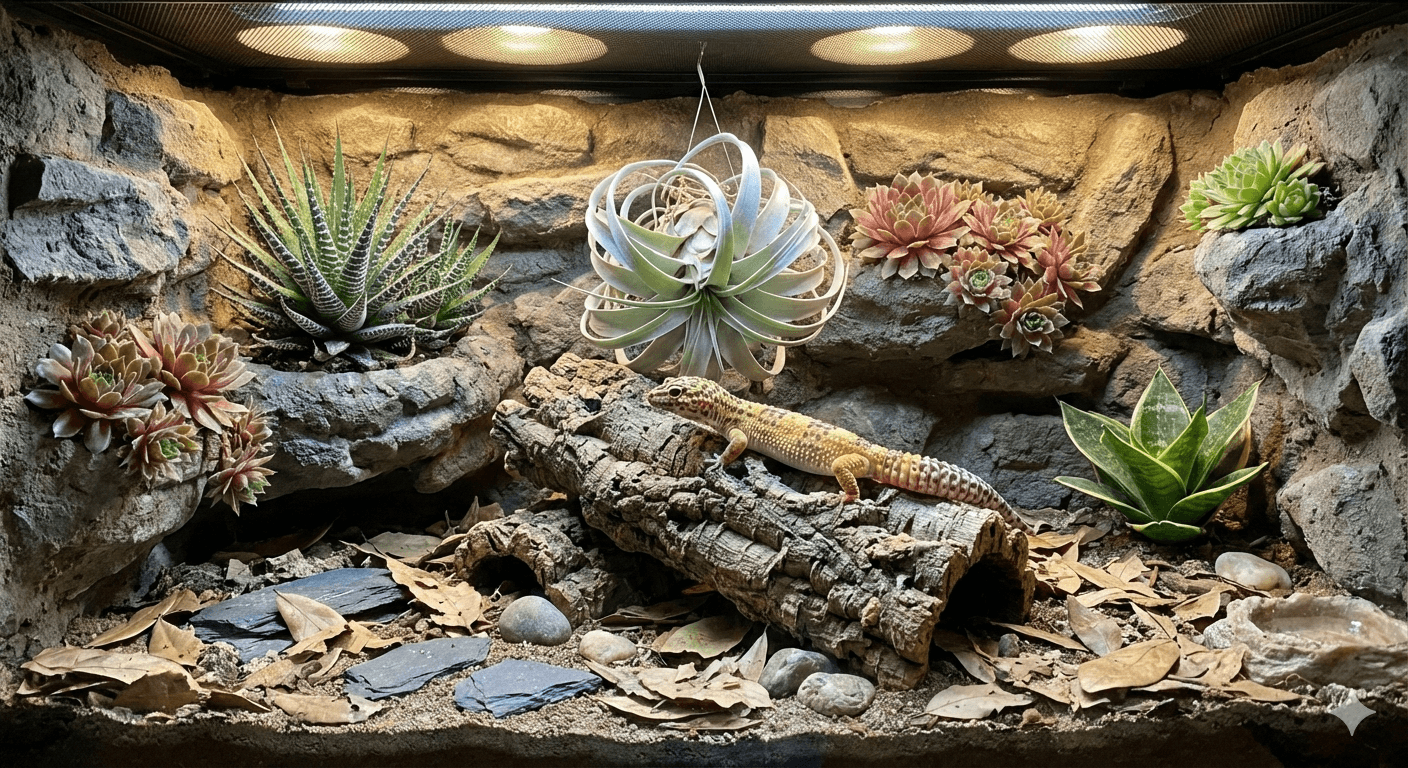
The Definitive Guide to the Best Plants for Leopard Gecko Terrariums: Science-Based Choices for Arid Setups
Discover the best safe, arid-adapted live plants for your leopard gecko's enclosure. Learn how to create a thriving, naturalistic habitat with expert advice on selection, lighting, and bioactive care.
As a certified herpetological care specialist and long-time reptile keeper, I often see a disconnect when people set up enclosures for arid species like the leopard gecko (Eublepharis macularius). We instinctively want lush, green terrariums, but putting a tropical fern in with a desert-dwelling gecko is a recipe for disaster—both for the plant and potentially the animal.
Creating a naturalistic or bioactive setup for a leopard gecko is incredibly rewarding. It provides enrichment, natural cover, and stable microclimates. However, it requires a specific approach bridging horticulture and herpetoculture. We aren't just gardening; we are engineering a micro-habitat that mimics the rocky, semi-arid regions of Pakistan and Afghanistan while ensuring plant survival indoors.
This guide will walk you through the science of selecting the best plants for leopard gecko terrariums, ensuring they are safe, robust, and suited to the unique environmental parameters of your reptile's home. Let's dive into how to bring a slice of the arid scrubland into your living room safely and effectively.
Understanding the Leopard Gecko’s Natural Habitat and Needs
To choose the right plants, we must first understand the environment we are trying to replicate. Contrary to popular belief, leopard geckos do not live in barren, rolling sand dunes. Their natural range includes rocky deserts, dry grasslands, and scrublands. These areas experience significant temperature fluctuations and distinct wet and dry seasons.
While the ambient humidity in their native range is generally low (often 30-40%), these geckos rely heavily on humid microclimates. In the wild, they spend their days tucked under large rocks or deep in burrows where humidity levels are significantly higher—often exceeding 70-80%. This is essential for hydration and proper shedding.
Therefore, the plants we choose must be xerophytic (adapted to dry conditions) to survive the ambient environment of the enclosure. They must tolerate periods of drought between thorough waterings. Furthermore, the substrate used to support these plants needs to be fast-draining to prevent root rot and maintain appropriate ambient humidity levels for the gecko. We are looking for plants that thrive in a gritty, soil-and-sand based mix, not rich potting soil.
Criteria for Selecting Safe and Thriving Terrarium Plants
When evaluating plants for a leopard gecko enclosure, I apply a strict checklist. The plant's aesthetics are secondary to safety and environmental compatibility. Here are the non-negotiables for a successful arid setup.
1. Toxicity and Safety: Leopard geckos are strictly insectivorous and will not actively eat plants. However, accidental ingestion can occur if an insect hides on a leaf or if the gecko is digging. Therefore, all plants must be non-toxic. We avoid anything that exudes irritating latex sap (like many Euphorbia species) or contains known high-level toxins like oxalates (e.g., Dumb Cane). Furthermore, physical safety is paramount; avoid cacti with sharp spines or glochids (hair-like barbs) that could injure the gecko's delicate skin or eyes.
2. Structural Integrity: Leopard geckos are surprisingly sturdy and clumsy climbers. They will clamber over anything low to the ground. Plants need to be robust enough to withstand being walked on, dug around, and occasionally sat upon. Delicate, trailing plants often get trampled in weeks. We need plants with thick cuticles, sturdy stems, or compact growth habits.
3. Lighting Requirements: This is a critical factor often overlooked. While leopard geckos are crepuscular (active at dawn and dusk) and do not require intense UVB like a bearded dragon, live plants absolutely require full-spectrum light to survive. A standard room light or heat lamp is insufficient. You must incorporate a 6500K LED grow light strip designed for planted tanks. Without this, even the hardiest succulents will stretch (etiolate), weaken, and eventually die. The bright light during the day also provides a beneficial photoperiod cue for your gecko.
Top Succulent Choices for Arid Enclosures
Succulents are the cornerstone of an arid leopard gecko setup. They are evolved to store water in their leaves and stems, making them perfectly suited for the "drench and dry" watering cycle required in these terrariums. However, not all succulents are created equal; some require far more intense sun than an indoor enclosure can provide.
- Haworthia and Haworthiopsis: These are my top recommendations for leopard geckos. They are tough, often have textured leaves that add visual interest, and crucially, they tolerate lower light levels than many other desert plants. They are accustomed to growing in the shade of rocks and bushes in the wild. Species like the Zebra Plant (Haworthiopsis fasciata) are readily available and virtually indestructible in a terrarium setting.
- Gasteria: Similar to Haworthia, Gasteria species (like 'Little Warty') have thick, tongue-shaped leaves and are very tolerant of lower light conditions. Their rough texture helps them stand up to gecko traffic.
- Sempervivum (Hens and Chicks): These are incredibly cold-hardy and drought-tolerant. They form low, tight rosettes that geckos love to use as stepping stones. They do require bright light to maintain their compact shape but are otherwise very easy to care for.
- Echeveria: These iconic rosette succulents come in stunning colors. They are safe and beautiful but require high light levels. Only use Echeveria if you have a high-output LED grow light positioned directly above them. Without adequate light, they will stretch unattractively and weaken quickly.
Non-Succulent Options: Grasses and Robust Foliage
While succulents are great, relying solely on them can make an enclosure look repetitive. Incorporating other plant types adds textural variety and creates different types of cover, mimicking a scrubland environment more effectively.
- Snake Plants (Dracaena trifasciata, formerly Sansevieria): The ultimate low-maintenance plant. Snake plants are incredibly tough, tolerate a wide range of light conditions, and thrive on neglect. Their upright growth habit provides excellent vertical cover without taking up much floor space. Look for dwarf varieties like 'Hahnii' for smaller enclosures, or use taller varieties as background plants.
- Arid Grasses and Sedges: Ornamental grasses can provide soft cover that geckos enjoy pushing through. Blue Fescue (Festuca glauca) is a great option that stays relatively small and adds a nice color contrast. Some sedges, like certain Carex varieties adapted to drier dunes, can also work well. Ensure the chosen grass is not sharp-edged.
- Peperomia (Succulent varieties): While many Peperomia are tropical, some have evolved succulent characteristics. Peperomia graveolens (Ruby Glow) or Peperomia dolabriformis have thick, taco-shaped leaves and are drought-tolerant enough for a leopard gecko setup if placed in the cooler, slightly less parched end of the tank.
Utilizing Vertical Space with Air Plants (Tillandsia)
Air plants (Tillandsia spp.) are a fantastic option for reptile enclosures because they do not require substrate. In nature, they are epiphytes, growing on tree branches or rocks and absorbing moisture and nutrients through specialized scales on their leaves.
This makes them perfect for adding greenery to hardscape elements like driftwood branches or rock walls where planting in soil is impossible. You can attach them using non-toxic aquarium silicone or fishing line. Geckos will often use larger air plants as elevated resting spots.
Care Note: While they don't need soil, they do need water. In an arid setup, misting them occasionally is usually insufficient due to rapid evaporation. The best way to water them is to remove them from the enclosure once a week and soak them in a bowl of lukewarm water for 30-60 minutes. Shake off excess water thoroughly before returning them to the tank to prevent rot in the core of the plant. Species with thicker, greyer leaves (like T. xerographica) are generally more drought-tolerant than those with fine, green leaves.
The Practical Guide to Planting and Maintenance in Bioactive Setups
Successfully keeping plants alive in a leopard gecko enclosure relies heavily on the substrate and watering technique. You cannot simply use bagged potting soil, as it retains too much moisture, raising ambient humidity dangerously high and leading to root rot for arid plants.
The ideal substrate is a DIY mix of roughly 60-70% organic topsoil (fertilizer and manure-free) and 30-40% play sand. This mixture provides enough organic matter for plant roots but drains quickly, replicating the sandy loam of their native habitat. For a true bioactive setup, you would add leaf litter and an arid-adapted cleanup crew, such as giant canyon isopods (Porcellio dilatatus) and arid springtails, which help break down waste and aerate the soil.
When watering, adopt a "target watering" approach. Instead of spraying the entire enclosure, use a watering can with a narrow spout to deliver water directly to the base of the plants, saturating the root zone thoroughly. Allow the soil to dry out almost completely before watering again. This deep watering encourages roots to grow downward, making the plants more stable and drought-resistant. Always monitor your enclosure's humidity with a digital hygrometer to ensure the ambient levels return to the 30-40% range a day after watering.
Conclusion
Transitioning to a planted or bioactive terrarium for your leopard gecko is a commitment that offers immense rewards. It moves beyond basic animal keeping into the realm of ecosystem management. By selecting robust, arid-adapted, and safe plants like Haworthia, Snake Plants, and Sempervivum, and pairing them with appropriate full-spectrum lighting and well-draining substrate, you can create a stunning slice of nature. This not only enhances the aesthetic appeal of the enclosure but, more importantly, provides your gecko with a complex, enriching environment that supports natural behaviors.
Frequently Asked Questions
Q1: Are cacti safe to use in a leopard gecko terrarium?
A: Generally, no. Traditional cacti with sharp spines pose a significant risk of physical injury to leopard geckos, whose skin is relatively delicate. Even "spineless" varieties often have glochids—tiny, barbed hairs that can embed in skin and eyes, causing infection. While a seemingly safe spineless Opuntia (prickly pear) pad might exist, the risk usually outweighs the reward. It is far safer to stick to succulent alternatives like Haworthia or Echeveria that offer a similar aesthetic without the danger.
Q2: Do I really need a grow light if my leopard gecko is nocturnal/crepuscular?
A: Yes, absolutely. While the gecko itself does not require intense light for metabolic health (though they do benefit from a clear day/night cycle), live plants cannot survive without photosynthetically active radiation (PAR). Without a proper LED plant light in the 6500K color temperature range, arid plants will starve, stretch out unattractively in search of light, and eventually die. The grow light is for the plants' life support, not the gecko's.
Q3: Can I just use fake plants instead of live ones?
A: Yes, high-quality artificial plants are a perfectly acceptable alternative if you are not ready for the husbandry requirements of live plants. They provide necessary cover and visual barriers, which are crucial for a gecko's sense of security. However, fake plants do not contribute to air quality, do not help regulate microclimates, and do not support a bioactive cleanup crew. If using fake plants, ensure they are sturdy, have no small detachable parts, and are easy to remove for regular cleaning and disinfection.
Q4: What should I do if my leopard gecko is digging up the plants?
A: Digging is a natural behavior for leopard geckos, often related to seeking a humid spot, trying to cool down, or sometimes putting eggs. If your gecko is constantly uprooting plants, first ensure their humid hide is adequate (warm and moist). To protect plants, try placing larger, flat river stones around the base of the plant stem. This armors the root zone and discourages digging directly underneath the plant while still allowing the gecko to dig elsewhere in the enclosure.
Recommended Products
Exo Terra Jungle Vine
Realistic vine that works great with live or artificial terrarium plants
Zoo Med Eco Earth Coconut Fiber
Natural substrate that supports live plant growth in bioactive setups