Best Panther Chameleon Enclosure: Top Picks & Setup
Discover the best panther chameleon enclosure for your setup. Screen vs. hybrid, size guides, top picks, and expert tips to keep your chameleon thriving.


This article contains affiliate links. If you make a purchase through these links, we may earn a small commission at no extra cost to you. See our affiliate disclosure for details.
We recommend 5 picks here. Our top choice is the Screen Chameleon Cage 24x24x48 — check price and availability below.
How we choose: we compare published specifications against the care requirements in veterinary and species-care literature, and weigh those against what long-time keepers report. We do not test products ourselves and we do not restate Amazon star ratings. The 5 sources behind this article are listed at the bottom.
Quick Comparison
- Product Type
- Screen Enclosure
- Primary Function
- Housing & Airflow
- Maintenance Frequency
- Occasional Cleaning
- Approximate Price
- $80-150
- Criticality for Chameleon Health
- Very Important (Airflow)
- Product Type
- UVB Lamp
- Primary Function
- Vitamin D3 Synthesis
- Maintenance Frequency
- 6-12 Month Replacement
- Approximate Price
- $20-40
- Criticality for Chameleon Health
- Essential (MBD Prevention)
- Product Type
- Automated System
- Primary Function
- Humidity & Hydration
- Maintenance Frequency
- Daily/Weekly Water Refill
- Approximate Price
- $100-250
- Criticality for Chameleon Health
- Highly Recommended (Consistent Hydration)
- Product Type
- Digital Gauge
- Primary Function
- Temperature/Humidity Monitoring
- Maintenance Frequency
- Infrequent Battery Change
- Approximate Price
- $15-30
- Criticality for Chameleon Health
- Essential (Environmental Control)
- Product Type
- Basking Lamp
- Primary Function
- Basking Heat Source
- Maintenance Frequency
- As-needed Replacement
- Approximate Price
- $10-25
- Criticality for Chameleon Health
- Very Important (Thermoregulation)
Prices are estimates only. Actual prices on Amazon may vary.
Panther chameleons are some of the most spectacular reptiles you can own. Their shifting colors, slow deliberate movements, and alien-like eyes make them genuinely captivating. But they're also one of the more demanding lizards to keep — and the enclosure is where that difficulty starts.
Get the enclosure right, and your panther chameleon can live 5–7 years in vibrant health. Get it wrong, and you'll be dealing with respiratory infections, stuck sheds, and stress-related illness within months. This guide walks you through exactly what you need — from cage material to size, setup, and our top picks.
Why the Enclosure Matters So Much
Panther chameleons (Furcifer pardalis) come from the humid coastal forests of Madagascar. They spend their entire lives in the trees, never touching the ground. Their bodies are tuned for constant airflow, dappled light, and climbing.
In captivity, their enclosure has to replicate that environment as closely as possible. Poor ventilation causes respiratory infections. Humidity that's too low causes dehydration and bad sheds. A cage that's too small creates chronic stress, which suppresses the immune system and leads to early death.
This isn't a lizard that tolerates a mediocre setup. But the right enclosure isn't complicated — you just need to know what you're looking for.
Screen vs Hybrid Enclosures
Side-by-side comparison
| Feature | Screen Cages | Hybrid Enclosures |
|---|---|---|
| Ventilation | ★Excellent cross-ventilation | Good airflow with solid back/sides |
| Humidity Retention | Poor — needs 2–3x daily misting | ★Good — maintains 60–80% easier |
| Ease of Setup | ★Simple, classic choice | Moderate complexity |
| Best For | Humid climates, reliable misting | Drier climates, beginners |
Our Take: Hybrids offer the best balance for most keepers — airflow without constant humidity struggle.
Panther Chameleon Enclosure Sizing Guide
Baby (0–3 months)
18" × 18" × 36"
Min: 16" × 16" × 30"
Juvenile (3–6 months)
24" × 24" × 36"
Min: 18" × 18" × 36"
Adult Male
36" × 24" × 48"
Min: 24" × 24" × 48"
Adult Female
24" × 24" × 36"
Min: 18" × 18" × 36" + lay bin
Golden Rule
Height > Width
Arboreal species — taller cages always better
DIY vs Ready-Made Enclosures
Side-by-side comparison
| Feature | Ready-Made Cages | DIY Build |
|---|---|---|
| Setup Time | ★Quick and hassle-free | Time-consuming, requires planning |
| Accessory Availability | ★Wide ecosystem of compatible gear | May need custom solutions |
| Customization | Limited to standard sizes | ★Full design control |
| Materials | ★Pre-made, tested | PVC foam/plywood + fiberglass screen required |
| Best For | First-time keepers, single animal | Custom sizes, multiple animals, permanent builds |
Our Take: Ready-made is the low-risk, smart choice for most first-time owners.
Detailed Reviews
1. Screen Chameleon Cage 24x24x48
Best Overall
Screen Chameleon Cage 24x24x48
Pros
- •Provides critical cross-ventilation for respiratory health.
- •Generous 24x24x48-inch dimensions accommodate adult panther chameleons.
- •Vertical design supports natural arboreal behavior.
- •Full mesh construction prevents stale air accumulation.
Cons
- •Struggles with humidity retention in dry climates, requiring frequent misting.
- •May require supplemental heating methods to maintain ambient temperatures.
- •Offers less visual privacy compared to solid-sided enclosures.
Bottom Line
This screen enclosure provides the essential cross-ventilation and vertical space required for adult panther chameleons, aligning with community standards. Its full mesh design is critical for respiratory health but necessitates careful humidity management.
2. Arcadia T5 HO UVB Bulb for Chameleons
Editor's Choice
Arcadia T5 HO UVB Bulb for Chameleons
Pros
- •Delivers vital high-output T5 UVB spectrum.
- •Facilitates essential vitamin D3 synthesis.
- •Crucial for proper calcium metabolism, preventing metabolic bone disease (MBD).
- •Supports immune function and overall long-term health.
Cons
- •Requires a compatible T5 HO fixture for operation.
- •Needs replacement every 6-12 months to maintain effective UVB output.
- •Initial setup cost may be higher than less effective UVB sources.
Bottom Line
This high-output T5 UVB bulb is a non-negotiable component for panther chameleon care, enabling crucial vitamin D3 synthesis. Its provision is essential for calcium metabolism, directly preventing metabolic bone disease.
3. Automatic Reptile Misting System
Premium Pick
Automatic Reptile Misting System
Pros
- •Automates humidity maintenance, ensuring consistent 60–80% levels.
- •Provides drinking water via fine mist droplets, mimicking natural hydration.
- •Significantly reduces daily manual misting efforts.
- •Helps prevent dehydration and stuck sheds.
Cons
- •Higher initial investment compared to manual misting equipment.
- •Requires a water reservoir that needs regular refilling.
- •Can lead to mold growth if not properly calibrated or maintained.
Bottom Line
This automated system maintains consistent humidity levels and provides essential drinking water droplets for panther chameleons. It streamlines daily care by automating one of the most labor-intensive aspects of their husbandry.
4. Digital Thermometer Hygrometer for Reptile Enclosures
Best Value
Digital Thermometer Hygrometer for Reptile Enclosures
Pros
- •Accurately monitors both temperature and humidity simultaneously.
- •Enables precise environmental adjustments to meet species-specific needs.
- •Helps identify and rectify unsuitable conditions before health impacts occur.
- •Easy-to-read digital display for quick verification.
Cons
- •Requires periodic battery replacement for continuous operation.
- •Accuracy can be compromised by incorrect probe placement.
- •Lower-quality models may have a shorter lifespan or reduced precision.
Bottom Line
A reliable digital thermometer and hygrometer combo is indispensable for precise environmental management within a chameleon enclosure. It provides accurate, real-time data to verify temperature and humidity, crucial for preventing health issues.
5. Halogen Basking Bulb for Reptiles
Budget Pick
Halogen Basking Bulb for Reptiles
Pros
- •Produces focused, directional heat for effective basking spots.
- •Mimics natural dappled sunlight, supporting species-appropriate thermoregulation.
- •More energy-efficient than standard incandescent bulbs.
- •Generally longer-lasting, reducing replacement frequency.
Cons
- •Requires a heat-resistant fixture with a ceramic socket.
- •Can create intense hot spots if not properly regulated or positioned.
- •May contribute to enclosure dehydration due to concentrated heat emission.
Bottom Line
Halogen flood bulbs provide efficient, directional heat that effectively mimics the dappled sunlight and warm basking spots found in a chameleon's natural habitat. They offer improved energy efficiency and longevity compared to traditional incandescent bulbs.
Screen, Hybrid, or Glass — Which Is Best?
This is the first decision most new owners struggle with. Here's the honest breakdown.
Screen Enclosures
Screen cages are the classic choice for panther chameleons. The open mesh provides excellent cross-ventilation, which is critical for preventing stale, humid air that breeds bacteria and mold. Airflow is one of the most important factors in chameleon health.
The downside is humidity retention. In dry climates or during winter when indoor heating dries out the air, a screen cage loses moisture fast. You'll need to mist 2–3 times daily, or run an [automatic reptile misting system](https://www.amazon.com/dp/B09WXZPP81?tag=krawlo-20 to keep humidity in the 60–80% range.
Best for: Humid climates, owners with a reliable misting system, anyone prioritizing airflow.
Hybrid Enclosures
Hybrid cages combine solid back and side panels — usually PVC or aluminum — with screen on the front and top. They hold humidity much better than full screen cages while still providing solid ventilation.
Many experienced keepers consider hybrids the best all-around option for panther chameleons. You get the airflow benefit without the constant humidity battle. If you live somewhere dry, this is likely your best bet.
Best for: Drier climates, beginners, anyone who wants less misting labor.
Glass Terrariums
Standard glass terrariums are not recommended for panther chameleons. Poor ventilation traps stale air, and the enclosed space makes temperature and humidity gradients difficult to manage. Glass also creates reflection issues — more on that in a moment.
The exception is a fully bioactive glass build with an active drainage layer, fans for cross-ventilation, and a carefully designed airflow system. That's an advanced technique not suited for most keepers.
What Size Enclosure Does a Panther Chameleon Need?
Size matters more than almost anything else — and height matters most of all. Panther chameleons are arboreal. They live in the upper third of their enclosure. A taller cage is almost always better than a wider one.
| Life Stage | Minimum Size | Recommended Size |
|---|---|---|
| Baby (0–3 months) | 16" × 16" × 30" | 18" × 18" × 36" |
| Juvenile (3–6 months) | 18" × 18" × 36" | 24" × 24" × 36" |
| Adult Male | 24" × 24" × 48" | 36" × 24" × 48" or larger |
| Adult Female | 18" × 18" × 36" | 24" × 24" × 36" |
Don't rush size upgrades. A hatchling in a huge enclosure struggles to find food, which causes stress. Scale up with the animal — move to juvenile sizing around 3–4 months, then adult sizing at 6+ months.
Adult Male Enclosure
The standard recommendation for adult males is a 24" × 24" × 48" screen cage — often called a "2x2x4" in the chameleon community. This is the minimum. A 36" × 24" × 48" gives even better room for climbing, thermoregulation, and natural movement.
Males are larger and more territorial than females. They need enough space to move freely between basking zones and cooler areas without feeling cramped.
Adult Female Enclosure
Females are smaller and less active. An 18" × 18" × 36" can technically work, but a 24" × 24" × 36" is a much better choice. There's one critical detail for females: you must always have a lay bin available — a deep container filled with moist substrate where she can deposit eggs. Without it, she'll retain eggs, which is often fatal. Plan that into your enclosure design from the start.
Baby and Juvenile Enclosures
Start smaller. A 16" × 16" × 30" is ideal for hatchlings. The smaller space helps them locate food easily, which reduces hunting stress. Move up to juvenile sizing around 3–4 months, then adult sizing after 6 months.
Will Your Chameleon Stress Over Reflections?
Yes — and this is more important than most people realize. Panther chameleons are highly territorial. When they see their own reflection, they perceive it as a rival male in their territory. The stress response is immediate and chronic.
In screen cages, this isn't an issue. With hybrid or glass setups, position the enclosure so it's not facing a mirror, a window, or another chameleon. Never house two males where they can see each other — even across a room.
Chronic territorial stress suppresses the immune system and significantly shortens a panther chameleon's lifespan. It's a welfare issue that gets overlooked.
DIY vs. Ready-Made: Which Should You Choose?
Both options can work well. Here's how to think about the decision.
Ready-made cages from established brands are easier to set up, easier to find accessories for, and offer predictable performance. They're the right call for most new keepers.
DIY enclosures shine when you need a custom size, want a permanent built-in setup, or are housing multiple animals. If you go this route:
- Use PVC foam board or sealed plywood — raw untreated wood absorbs moisture and grows mold fast.
- Use fiberglass screen mesh, not aluminum. Panther chameleons have delicate toe pads and small nails. Sharp metal screen edges can cause injuries over time.
- Include screen on at least two sides — front and top is the standard. Cross-ventilation is non-negotiable.
For most first-time owners, a [ready-made screen cage](https://www.amazon.com/dp/B01N3BCHWJ?tag=krawlo-20 is the smart, low-risk starting point.
Setting Up the Enclosure: What Goes Inside
The cage itself is just the shell. Here's what makes the setup complete.
UVB and Basking Lighting
Lighting is non-negotiable for panther chameleons. You need two distinct light sources.
UVB lighting: Panther chameleons require high-output UVB — a T5 HO bulb rated at 6% or 12% is standard. The Arcadia 6% or 12% T5 HO bulbs are highly regarded by experienced keepers. Without proper UVB, your chameleon can't metabolize calcium, and metabolic bone disease follows quickly.
Basking light: A halogen flood or incandescent bulb creates a basking spot at 85–90°F directly at the top of the enclosure. Ambient temperature should be 72–80°F during the day. Night temps can drop to 60–70°F — panther chameleons actually benefit from this natural cool-down period.
Position your [basking light fixture](https://www.amazon.com/dp/B0GXVKNVRN?tag=krawlo-20 above the screen, not inside the cage. This prevents burns and creates a natural overhead heat gradient.
Plants and Climbing Structure
Live plants are strongly preferred over fake ones. They regulate humidity naturally, provide visual barriers that reduce stress, and create a more stimulating environment. Good chameleon-safe plant options include:
- Pothos (Epipremnum aureum) — practically indestructible and excellent for coverage
- Hibiscus (Hibiscus rosa-sinensis) — chameleons often eat the leaves and flowers
- Umbrella plant (Schefflera arboricola) — sturdy and great for climbing
- Ficus (Ficus benjamina) — provides dense coverage and holds humidity well
Add natural cork bark tubes and branches at multiple heights. You want horizontal perches in the basking zone near the top, mid-level perches for rest and movement, and lower perches near the cooler, shadier base of the enclosure.
Misting and Humidity
Target 60–80% relative humidity. A reptile automatic misting system set to mist 2–3 times daily makes this achievable without constant manual effort.
Chameleons don't drink from water dishes. They lap water droplets off leaves. Make sure your misting saturates the plants thoroughly each session. A digital thermometer/hygrometer combo lets you verify that your numbers are actually hitting the target.
Substrate
Because panther chameleons rarely touch the floor, substrate is lower priority than it is for most reptiles. Simple options include:
- Bare bottom with a drainage layer — easiest to clean
- Paper towels — highly practical for daily spot cleaning
- Bioactive setup — drainage layer (leca balls + mesh) topped with a bioactive soil mix. Great for naturalistic setups but requires more planning.
For egg-laying females, keep a separate container with 8–12 inches of moist soil ready at all times. This isn't optional — egg retention in female chameleons is a medical emergency.
Shopping Tips Before You Buy
A few practical things to check before clicking purchase:
- Measure your space. A 48" cage needs at least 5.5 feet of vertical clearance once you account for the lighting rig above it.
- Check the door design. Front-opening doors are far easier to work with daily than top-access panels. You want to be able to reach in without disturbing your chameleon.
- Verify the mesh material. Fiberglass is chameleon-safe. Some budget cages still use aluminum mesh with sharp cut edges.
- Think about the ecosystem. Does the brand offer matching misters, dripper systems, or lighting mounts? Integrated accessories make the setup process much smoother.
For a full breakdown of this species beyond the enclosure, our Panther Chameleon Care: Complete Guide for Keepers covers feeding, lighting schedules, health monitoring, and more. If you're still weighing whether a panther chameleon is the right choice for you, our Best Pet Lizards for Beginners: 11 Species Ranked gives an honest comparison across difficulty levels.
Our Top Enclosure Comparison
(Estimates only — actual prices on Amazon may vary.)
| Enclosure Type | Material | Ideal Size | Best For | Approx. Cost |
|---|---|---|---|---|
| Screen cage | Aluminum frame + fiberglass mesh | 24"×24"×48" | Most climates, beginners | $80–$150 |
| Hybrid PVC cage | PVC panels + screen front/top | 36"×18"×48" | Dry climates, humidity control | $200–$400 |
| DIY PVC build | PVC foam board | Custom | Large setups, experienced keepers | $100–$300 |
For most first-time panther chameleon owners, a 24"×24"×48" screen cage paired with a good misting system is the proven starting point. It's affordable, easy to accessorize, and gives your chameleon the airflow it needs.
If you're in a dry climate — or just want easier humidity management — a hybrid enclosure is worth the extra investment. The reduced misting labor alone pays off quickly.
Final Thoughts
The best panther chameleon enclosure prioritizes four things: tall vertical space, excellent airflow, humidity control, and room to climb. Screen cages deliver on airflow. Hybrids deliver on humidity. Glass delivers on neither.
Shoot for at least 24" × 24" × 48" for an adult male. Add live plants, proper T5 HO UVB lighting, a halogen basking spot, and an automated mister — and you'll have a setup your panther chameleon can genuinely thrive in. Don't treat the enclosure as an afterthought. It's the foundation that everything else builds on.
Our Final Verdict
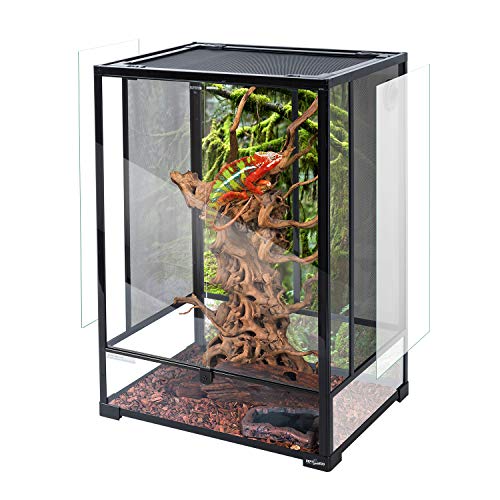
Screen Chameleon Cage 24x24x48
This screen enclosure provides the essential cross-ventilation and vertical space required for adult panther chameleons, aligning with community standards. Its full mesh design is critical for respiratory health but necessitates careful humidity management.

Arcadia T5 HO UVB Bulb for Chameleons
This high-output T5 UVB bulb is a non-negotiable component for panther chameleon care, enabling crucial vitamin D3 synthesis. Its provision is essential for calcium metabolism, directly preventing metabolic bone disease.

Automatic Reptile Misting System
This automated system maintains consistent humidity levels and provides essential drinking water droplets for panther chameleons. It streamlines daily care by automating one of the most labor-intensive aspects of their husbandry.
Frequently Asked Questions
A screen cage or hybrid enclosure in the 24" × 24" × 48" size range is considered the best for adult male panther chameleons. Screen cages provide excellent airflow, which is critical for respiratory health. Hybrid cages (solid back/sides with screen front and top) are better for dry climates since they retain humidity more effectively. Glass terrariums are generally not recommended due to poor ventilation.
References & Sources
- https://reptifiles.com/panther-chameleon-care-sheet/
- https://www.thebiodude.com/blogs/chameleon-caresheets/the-care-and-bioactive-maintenance-of-the-panther-chameleon?srsltid=AfmBOopcz4cEoJpRH603DHWrFqiCNCVLYFDo8HObRQ6BYBEgUIJSyaeu
- https://www.zenhabitats.com/blogs/reptile-care-sheets-resources/panther-chameleon-care-sheet-reptifiles?srsltid=AfmBOoo5WeUcSqMAOq6NUNG4Ux5nDaOqjz6aWdUoTgUl3GI-hI3zaG_E
- https://reptifiles.com/wp-content/uploads/2021/09/Panther-Chameleon-Care-Sheet-ReptiFiles.pdf
- https://www.thesprucepets.com/panther-chameleon-7197791
Related Articles

Best Plants for Your Chameleon Enclosure: A Krawlo Guide
Discover the best plants for your chameleon enclosure, from safe live options to essential faux choices. Create a thriving, natural habitat with our expert guide.

Finding the Best Chameleon Enclosure: A 2026 Guide
Choosing the best chameleon enclosure is key to a healthy pet. This guide covers the top picks for size, material (screen vs. glass), and setup for 2026.

Best Panther Chameleon Heating: Complete Setup Guide
Get panther chameleon heating right with our complete guide — basking temps, bulb types, wattage, positioning tips, and burn prevention for healthy chameleons.