Best Heat Lamp for Pacman Frog: 7 Top Choices (2026)
Find the best heat lamp for your pacman frog. We cover top picks, temperature ranges, common mistakes, and exactly how to keep your frog warm and healthy.


This article contains affiliate links. If you make a purchase through these links, we may earn a small commission at no extra cost to you. See our affiliate disclosure for details.
We recommend 5 picks here. Our top choice is the Ceramic Heat Emitter (CHE) - 25-40W — check price and availability below.
How we choose: we compare published specifications against the care requirements in veterinary and species-care literature, and weigh those against what long-time keepers report. We do not test products ourselves and we do not restate Amazon star ratings. The 5 sources behind this article are listed at the bottom.
Quick Comparison
- Heat Source Location
- Overhead/ambient (air)
- Light Output
- None (no light)
- Recommended Wattage
- 25-40W for 10-20 gal
- 24/7 Safe Use
- Yes
- Thermostat Required
- Yes
- Moisture Impact
- Moderate (can dry if overused)
- Heat Source Location
- Substrate penetrating (infrared)
- Light Output
- Infrared only (no visible light)
- Recommended Wattage
- 50-80W depending on setup
- 24/7 Safe Use
- Yes
- Thermostat Required
- Yes
- Moisture Impact
- Low (substrate-focused)
- Heat Source Location
- Overhead (air with light)
- Light Output
- White light emitted
- Recommended Wattage
- 15-25W daytime only
- 24/7 Safe Use
- No (daytime only)
- Thermostat Required
- Yes
- Moisture Impact
- High (white light increases evaporation)
- Heat Source Location
- Ambient (even distribution)
- Light Output
- None (no light)
- Recommended Wattage
- Varies by model
- 24/7 Safe Use
- Yes
- Thermostat Required
- Yes
- Moisture Impact
- Low
- Heat Source Location
- Below substrate (underside)
- Light Output
- None (no light)
- Recommended Wattage
- Varies by model
- 24/7 Safe Use
- Yes (but not recommended)
- Thermostat Required
- Yes (hard to manage)
- Moisture Impact
- None (substrate stays moist)
Prices are estimates only. Actual prices on Amazon may vary.
Pacman frogs are one of the most low-maintenance amphibians you can keep — but get their temperature wrong and they'll stop eating, get sick, or go into a stress-induced torpor. The good news? Picking the best heat lamp for your pacman frog is simpler than most guides make it sound.
This guide cuts through the noise. You'll learn exactly what temperature range your frog needs, which heating options actually work (and which ones don't), and the most common mistakes new keepers make.
Why Heating Matters So Much for Pacman Frogs
Pacman frogs (Ceratophrys species) come from South America — humid, warm grasslands and forests where temperatures rarely dip below 65°F. They're ectotherms, meaning they rely entirely on their environment to regulate body temperature.
When your frog is too cold, its metabolism slows. Digestion stops. The immune system weakens. A pacman frog that won't eat is often a cold pacman frog, not a picky one.
The target ambient temperature for a pacman frog enclosure is 75–82°F (24–28°C) during the day, with a slight drop to 68–75°F (20–24°C) at night. You want gentle, ambient warmth — not a hot basking spot like you'd provide for a bearded dragon.
That distinction matters a lot when choosing your heating method.
CHE vs DHP: Head-to-Head Comparison
Side-by-side comparison
| Feature | Ceramic Heat Emitter (CHE) | Deep Heat Projector (DHP) |
|---|---|---|
| Light Emission | Zero light output | Infrared only (no light) |
| 24/7 Use | Yes, no day/night disruption | Yes, no day/night disruption |
| Heat Distribution | Ambient air from above | ★Penetrates substrate naturally |
| Best For | Standard enclosures | Bioactive/naturalistic setups |
| Cost | ★Budget-friendly | Higher upfront investment |
| Thermostat Required | Yes (non-negotiable) | Yes (non-negotiable) |
Our Take: CHE is the most popular choice for standard setups; DHP offers superior thermoregulation for bioactive enclosures.
Temperature & Schedule Quick Reference
Daytime Temperature
75–82°F (24–28°C)
Maintain with heat lamp on thermostat
Nighttime Temperature
68–75°F (20–24°C)
Natural slight drop supports health
Light Cycle
12 hours on / 12 hours off
Essential for natural activity rhythms
Lighting Type
6500K daylight LED (low-wattage)
No UVB required for pacman frogs
Danger Zone
Above 85°F (29°C)
Temperatures here cause stress and illness
Complete Pacman Frog Heating Setup Checklist
Everything you need to get started
Detailed Reviews
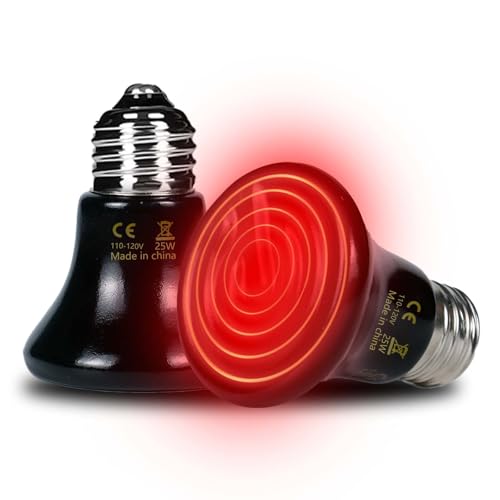
1. Ceramic Heat Emitter (CHE) - 25-40W
Best Overall
Ceramic Heat Emitter (CHE) - 25-40W
Pros
- •No light output (24/7 safe use)
- •Gentle ambient warmth
- •Hands-off operation
- •Widely available
- •Works with standard sockets
Cons
- •Can reduce humidity if enclosure lacks moisture retention
- •Requires thermostat
- •Heats from above (less uniform than substrate heating)
Bottom Line
The most popular and beginner-friendly heating choice for pacman frogs. Produces zero light for 24/7 use without disrupting day/night cycles. Screws into a standard incandescent socket and pairs easily with a thermostat.
2. Deep Heat Projector (DHP) - Arcadia 50W or 80W
Premium Pick
Deep Heat Projector (DHP) - Arcadia 50W or 80W
Pros
- •Penetrates substrate (naturalistic heating)
- •Supports thermoregulation at substrate level
- •Mimics solar warmth
- •Excellent for bioactive enclosures
Cons
- •More expensive upfront
- •Requires thermostat
- •Specialized technology
Bottom Line
Advanced infrared technology that penetrates the substrate to warm from within, mimicking natural solar heating. Ideal for bioactive setups where your frog spends most time buried.
3. Low-Wattage Incandescent or Halogen Bulb - 15-25W
Budget Pick
Low-Wattage Incandescent or Halogen Bulb - 15-25W
Pros
- •Cheap
- •Easy to find
- •Quick heat output
Cons
- •Emits white light (disrupts night cycle)
- •Daytime use only
- •Requires separate nighttime solution
- •Adds setup complexity
Bottom Line
Cheap and easy to find, but emits white light that disrupts the frog's natural day/night cycle. Useful only for daytime supplemental warming; requires a separate nighttime heating solution.
4. Radiant Heat Panel (RHP)
Runner Up
Radiant Heat Panel (RHP)
Pros
- •Even heat distribution
- •Long lifespan
- •Consistent performance
Cons
- •Higher cost
- •Requires mesh lid compatibility
- •More complex installation
Bottom Line
Provides even, consistent ambient heat with a long lifespan. Works well for larger enclosures but requires careful setup with mesh lids.
5. Under-Tank Heater (UTH)
Not Recommended
Under-Tank Heater (UTH)
Pros
- •Cheap
- •Widely available
Cons
- •Thermal burn risk when buried
- •Difficult to thermostat accurately
- •Belly heat is unnatural and dangerous for burrowing species
Bottom Line
Widely marketed for amphibians but unsuitable for pacman frogs. Heat from below poses burn risk when frogs burrow into substrate.
Do Pacman Frogs Even Need a Heat Lamp?
Honestly — not always. If your room temperature stays consistently between 72–80°F, your frog may be fine without any supplemental heat at all. Plenty of keepers in warmer climates skip the lamp entirely.
But if your home dips below 70°F in the evening or during winter, you'll need a heat source. The best heat lamp for a pacman frog is usually a low-wattage option that raises ambient temperature without drying out the enclosure.
Pacman frogs are moisture-dependent. Their skin absorbs water directly from the substrate and air. Strong overhead heat lamps — the kind designed for basking reptiles — will destroy humidity faster than you can mist. That's mistake #1 among beginners.
Best Heating Options for Pacman Frogs
Let's look at the main options side by side.
| Heating Method | Pros | Cons | Best For |
|---|---|---|---|
| Ceramic Heat Emitter (CHE) | No light, 24/7 use, gentle warmth | Can dry enclosure if overused | Most common choice |
| Deep Heat Projector (DHP) | Penetrates substrate, mimics solar warmth | More expensive upfront | Bioactive and naturalistic setups |
| Low-wattage incandescent bulb | Cheap, easy to find | Emits white light (disrupts night cycle) | Daytime use only |
| Radiant Heat Panel (RHP) | Even heat, long lifespan | Requires mesh lid, higher cost | Larger enclosures |
| Under-tank heater (UTH) | Cheap, widely available | Risk of burns, blocks thermostat probe | Not recommended for pacman frogs |
Ceramic Heat Emitter (CHE)
A [ceramic heat emitter](https://www.amazon.com/dp/B096JWWQMC?tag=krawlo-20 is the most popular choice — and for good reason. It produces zero light, so you can run it around the clock without disrupting your frog's day/night rhythm. It screws into a standard incandescent socket.
For a typical 10–20 gallon pacman frog enclosure, a 25–40 watt CHE is usually enough. Pair it with a thermostat (non-negotiable — more on that below) and you've got a reliable, hands-off heating solution.
The main downside: CHEs heat the air from above, which can reduce surface humidity if your enclosure doesn't have good moisture retention. Use a deep layer of moist substrate and mist regularly to compensate.
Deep Heat Projector (DHP)
The Deep Heat Projector is a newer technology originally developed for reptiles, but it works beautifully for pacman frogs. Instead of just warming the air, the DHP emits infrared radiation (IRA and IRB) that penetrates the substrate — warming it from within, much like sunlight does in the wild.
For keepers using a bioactive setup with naturalistic substrate, the DHP is arguably the best heat lamp for a pacman frog available right now. It supports thermoregulation at the substrate level, which is where your frog spends most of its time buried.
It's pricier than a basic CHE, but the naturalistic heating profile is hard to beat. Check our Best Pac Man Frog Heating: A Complete Setup Guide (2026) for a deeper breakdown of how DHPs work in practice.
Low-Wattage Incandescent or Halogen Bulb
A [low-wattage incandescent bulb](https://www.amazon.com/dp/B0B3VFD8FB?tag=krawlo-20 (15–25W) can work for daytime ambient warming, but it emits white light. That means you can't use it at night without disturbing your frog. If you go this route, you'll need a separate nighttime solution — usually a CHE or heat mat on a thermostat.
For most keepers, this adds complexity without much benefit. A CHE handles both day and night more simply.
Under-Tank Heaters — Why We Don't Recommend Them
Under-tank heaters (UTHs) are often marketed for amphibians, but they're a poor fit for pacman frogs. Here's why:
Pacman frogs burrow into the substrate when they feel threatened or want to thermoregulate. If your UTH is running hot underneath that substrate, your frog can sustain thermal burns — and these are hard to spot until serious damage is done.
Stick with overhead or ambient heat sources. Your frog's belly should never be the hottest part of its body.
You Must Use a Thermostat
This is non-negotiable. Any heat source — lamp, CHE, DHP — must be connected to a thermostat. Without one, your enclosure can overheat quickly. Temperatures above 85°F are dangerous for pacman frogs.
A simple [pulse proportional thermostat](https://www.amazon.com/dp/B01I15S6OM?tag=krawlo-20 or on/off thermostat works well for CHEs and DHPs. Set the probe at substrate level — that's where your frog lives.
For a full comparison of heating accessories across different species, see our Best Heat Lamps For Reptiles Comparison.
Pacman Frog Temperature & Lighting Schedule
Pacman frogs don't need UVB lighting the way reptiles do, but they do benefit from a consistent photoperiod — about 12 hours of light and 12 hours of darkness. This supports their natural activity rhythms.
If you're using a CHE for heat (which produces no light), you'll need a separate low-wattage LED or fluorescent bulb to provide the light cycle. A 6500K daylight LED on a timer does the job perfectly.
| Time of Day | Temperature Target | Light Status |
|---|---|---|
| Daytime (12 hrs) | 75–82°F (24–28°C) | On |
| Nighttime (12 hrs) | 68–75°F (20–24°C) | Off |
Note: Pacman frogs don't need UVB — but some keepers offer low-level UVB (5.0 or less) as a supplemental benefit. It's not required for healthy captive animals.
Setting Up Your Pacman Frog Enclosure for Heat
Getting the heating right is really about the whole enclosure setup working together. Here's what matters:
Enclosure Size and Material
A 10-gallon tank is the minimum for an adult pacman frog. A 20-gallon is better. Glass enclosures are common, but they lose heat faster than PVC or foam-backed setups. If your home is cool, a glass tank will demand more from your heating system.
Mesh lids are essential for ventilation — but they also let heat escape. Some keepers partially cover the mesh with a piece of aluminum foil or glass to retain warmth and humidity.
Substrate Depth and Moisture
Pacman frogs need 3–4 inches of moist substrate to burrow in. [Coconut coir](https://www.amazon.com/dp/B001F9COL8?tag=krawlo-20 topsoil, or a bioactive mix all work well. The substrate acts as a thermal buffer — if it's deep and moist, it holds heat more evenly and reduces the drying effect of overhead heat.
Moist substrate also means your CHE or DHP doesn't need to work as hard to maintain humidity. It's a system, not just a single product.
Thermometer Placement
You need two temperature readings: air temperature near the top, and substrate temperature at frog level. A digital probe thermometer with dual sensors is ideal. Don't rely on stick-on analog thermometers — they're notoriously inaccurate.
Common Beginner Mistakes (And How to Avoid Them)
These are the heating mistakes we see most often with new pacman frog keepers:
Using too high a wattage. A 100W reptile basking bulb will cook your frog and destroy humidity. Start with 25W and adjust from there.
Skipping the thermostat. Without temperature control, ambient heat changes can spike your enclosure into dangerous territory. Always use a thermostat.
Relying on UTHs. As mentioned above, belly heat is risky for burrowing frogs. Overhead or ambient sources only.
Using red or blue "night" bulbs. These are a myth. Frogs can see red light, and it disrupts their natural cycle. A CHE provides nighttime heat without any light.
Placing the heat source inside the enclosure. Heat lamps and CHEs always go outside and above the enclosure — on the screen lid, pointed down. Never inside.
What Wattage Do You Need?
(Estimates only — actual prices on Amazon may vary.)
The right wattage depends on your room temperature and enclosure size. Here's a rough guide:
| Room Temp | Enclosure Size | Recommended CHE Wattage |
|---|---|---|
| 70–75°F | 10-gallon | 25W |
| 70–75°F | 20-gallon | 40W |
| 65–70°F | 10-gallon | 40–60W |
| 65–70°F | 20-gallon | 60–75W |
| Below 65°F | Any | 75–100W + insulation |
Always confirm with a thermostat. These are starting points, not guarantees.
Best Heat Lamp for Pacman Frog: Our Top Picks
Here are the products we'd actually buy:
For most keepers: A [25–40W ceramic heat emitter](https://www.amazon.com/dp/B0FGVCXJ58?tag=krawlo-20 paired with an on/off thermostat. It's the most reliable, affordable, and beginner-friendly option on the market.
For naturalistic or bioactive setups: The [Arcadia Deep Heat Projector](https://www.amazon.com/dp/B0BSHS996Y?tag=krawlo-20 in the 50W or 80W size. It's the best heat lamp for a pacman frog if you want to replicate natural heat distribution in the substrate.
For keepers in very warm rooms (75°F+): You may not need any supplemental heat. Monitor your temperatures for a week before adding any heating device. Less is more with pacman frogs.
For a broader look at how pacman frog heat options compare to other species, our Best Reptile Heat Lamp: Top Picks for Every Species breaks it all down in one place.
Quick Reference: Pacman Frog Heating at a Glance
| Parameter | Target |
|---|---|
| Daytime ambient temp | 75–82°F (24–28°C) |
| Nighttime ambient temp | 68–75°F (20–24°C) |
| Substrate temp | 72–78°F (22–26°C) |
| Humidity | 70–80% |
| UVB required? | No (optional low-level) |
| Thermostat required? | Yes, always |
| Light cycle | 12 hours on, 12 off |
Final Thoughts
Pacman frogs are forgiving in a lot of ways — but temperature is one place they'll punish mistakes quickly. The good news is that once your heating setup is dialed in with a thermostat and the right heat source, it practically runs itself.
Start with a ceramic heat emitter and a quality thermostat. Monitor your temperatures with a dual-probe thermometer. Keep that substrate moist. Your frog will thank you with a healthy appetite and a lot of dramatic ambush hunting.
Our Final Verdict
Ceramic Heat Emitter (CHE) - 25-40W
The most popular and beginner-friendly heating choice for pacman frogs. Produces zero light for 24/7 use without disrupting day/night cycles. Screws into a standard incandescent socket and pairs easily with a thermostat.

Deep Heat Projector (DHP) - Arcadia 50W or 80W
Advanced infrared technology that penetrates the substrate to warm from within, mimicking natural solar heating. Ideal for bioactive setups where your frog spends most time buried.

Low-Wattage Incandescent or Halogen Bulb - 15-25W
Cheap and easy to find, but emits white light that disrupts the frog's natural day/night cycle. Useful only for daytime supplemental warming; requires a separate nighttime heating solution.
Frequently Asked Questions
The best approach is a low-wattage ceramic heat emitter (CHE) placed on top of the screen lid, connected to a thermostat. Set the thermostat probe at substrate level and target 75–82°F during the day and 68–75°F at night. Moist, deep substrate helps retain heat and humidity at the same time.
References & Sources
- https://www.thebiodude.com/blogs/frog-caresheets/care-and-bioactive-maintenance-of-the-pacman-frog?srsltid=AfmBOoqwEd7E1sNvsZct885Wky_NFmr9iC_oqB1r44YmIslFic7ibKhQ
- https://dubiaroaches.com/blogs/amphibian-care/pacman-frog-care-sheet?srsltid=AfmBOooGRHfjQhna6S2z6d1Kk2YuaA7YxLb0tVlOZ5MbrsWu-fpHmmpn
- https://zoomed.com/pac-man-frog/
- https://www.petmd.com/reptile/pacman-frog-care-sheet
- https://www.thesprucepets.com/pacman-frogs-as-pets-1236716
Related Articles

Best Substrate for Pacman Frog: A Keeper's Guide (2026)
Choosing the best substrate for your Pacman frog is crucial for their health. Our 2026 guide reviews top picks like coco fiber and bioactive mixes, and what to avoid.

Best White's Tree Frog Lighting: Top Picks 2026
Find the best White's tree frog lighting setup with our top UVB picks, wattage guide, and expert tips to keep Litoria caerulea healthy and thriving.

Best White's Tree Frog Substrate: Top 5 Picks
Find the best White's tree frog substrate to keep your frog healthy and thriving. We compare coconut fiber, bioactive mixes, sphagnum moss, and more.